
What Is Chemical and Mechanical Decontamination Used For?

Clean paint is not always truly clean. A vehicle can look freshly washed and still feel rough under your hand because tiny contaminants are bonded to the surface. Brake dust, rail dust, tar, tree sap, road film, mineral deposits, and industrial fallout can cling to clear coat in ways normal soap cannot remove.
That is where chemical and mechanical decontamination come in. In auto detailing, these two methods remove bonded contamination before polishing, protection, or inspection. They help restore smoothness, improve gloss, and give waxes, sealants, and coatings a much better surface to bond to.

What chemical decontamination does
Chemical decontamination uses dedicated cleaners to dissolve, loosen, or break down specific types of bonded contamination. Instead of scrubbing the surface harder, the product does the work at a chemical level.
A normal car wash removes loose dirt, dust, and mud. Chemical decontamination targets the things that remain after washing.
Common chemical decontamination products include:
Iron removers
These react with embedded iron particles from brake dust, rail dust, and industrial fallout.
Tar removers
These soften tar, asphalt specks, and some sticky road grime.
Water spot removers
These help break down mineral deposits left by hard water.
Bug and sap removers
These loosen organic residue that can cling tightly to paint and glass.
All-purpose cleaners or degreasers
These can help with oily grime on lower panels, wheel wells, and trim when used correctly.
Iron remover is one of the most common chemical decontamination products in detailing. It is often sprayed onto clean, wet paint or wheels. As it reacts with iron particles, it changes color, often turning purple or reddish. That color change does not mean the paint is being damaged. It means the product is reacting with iron contamination.
Chemical decontamination is useful because it reduces the amount of physical rubbing needed. Less rubbing means less chance of adding swirls or fine scratches. This matters most on dark paint, soft paint, or vehicles that have already been polished.
What mechanical decontamination does
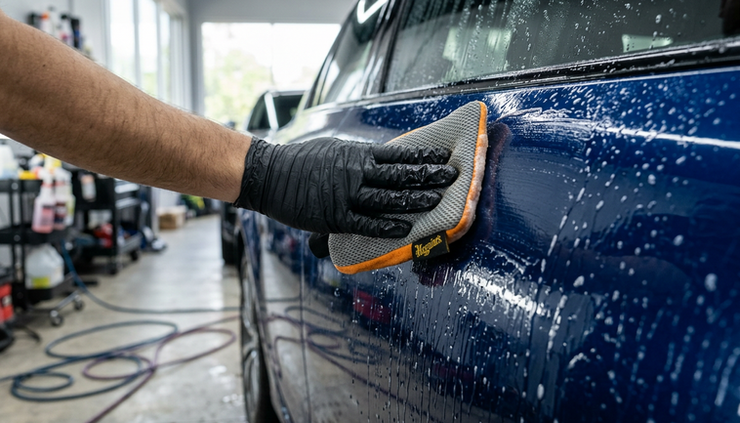
Mechanical decontamination physically removes bonded particles from the surface. The most common tools are clay bars, clay mitts, clay towels, and synthetic clay pads.
These tools glide across lubricated paint and shear off contamination that sits above the surface. After mechanical decontamination, paint usually feels much smoother. The classic test is simple: place your hand inside a thin plastic sandwich bag and gently run your fingertips over clean paint. If it feels gritty or bumpy, bonded contaminants are still present.
Mechanical decontamination can remove residue that chemicals may not fully handle, such as:
Overspray
Stubborn road film
Fine embedded grime
Some tree sap residue
Paint transfer in light cases
Contamination left after iron or tar removal
The tradeoff is that mechanical methods touch the paint. If the surface is dirty, dry, or poorly lubricated, clay can mar the clear coat. Marring looks like faint hazing, dullness, or fine scratches. This is why detailers usually wash first, use chemical decontamination next, and clay only when needed.
Why both methods are often used together
Chemical and mechanical decontamination solve different problems. One is not always a replacement for the other.
Chemical products are great for contamination that can be dissolved or chemically reacted with. Iron fallout, tar, and mineral deposits respond well to the right chemicals. Clay is better for contamination that is physically stuck to the surface and does not fully dissolve.
Used together, they create a cleaner and safer process.
A common order looks like this:
Wash the vehicle thoroughly.
Rinse away loose dirt and soap.
Apply iron remover where needed.
Rinse well.
Treat tar, sap, or mineral deposits if present.
Rinse again.
Use clay with proper lubrication if the paint still feels rough.
Rinse or wipe clean.
Dry the vehicle.
10. Inspect the paint before polishing or protection.
This order matters. Chemicals remove a large amount of contamination before clay touches the paint. That means the clay has less work to do and is less likely to drag sharp particles across the clear coat.
For many vehicles, chemical decontamination may be enough. For neglected vehicles, daily drivers, white cars with visible orange specks, or cars parked near railways or industrial areas, both methods may be needed.
What decontamination is used for before polishing
Decontamination is one of the key prep steps before Paint Correction. Polishing dirty or contaminated paint can create problems. A polishing pad spins or oscillates against the surface. If bonded particles are still present, the pad can pick them up and drag them across the clear coat.
That can cause extra swirls, uneven polishing, and faster pad contamination.
Clean paint gives polishing compounds a better chance to do their job. The pad stays cleaner. The polish breaks down more predictably. The detailer can see the true condition of the paint instead of fighting hidden grime.
Decontamination also helps with inspection. Once bonded contaminants are removed, defects become easier to identify. Swirls, water spot etching, oxidation, and scratches stand out more clearly under proper lighting.
This does not mean clay should be used before every light polish. If the paint already feels smooth after washing and chemical treatment, aggressive mechanical decontamination may not be necessary. The goal is not to clay for the sake of claying. The goal is to create a clean surface with the least amount of paint contact needed.
What decontamination is used for before protection
Waxes, sealants, and coatings bond best to clean paint. Contamination can act like a barrier between the protection and the clear coat.
If protection is applied over bonded grime, several things can happen:
The finish may not feel as slick as expected.
Gloss may look muted.
Water behavior may be uneven.
Protection may not last as long.
Coatings may bond poorly or appear patchy.
This is especially important before a Ceramic coating. Coatings need careful surface preparation because they are designed to form a durable bond. Any leftover film, embedded particles, polishing oils, or mineral residue can affect the final result.
Even a simple spray sealant performs better on a properly cleaned surface. Smooth paint allows the product to spread evenly and cure more consistently.
Think of decontamination as surface preparation, not just extra cleaning. Paint protection is only as good as the surface underneath it.

Signs a vehicle needs decontamination
The easiest sign is texture. After a proper wash, lightly glide clean fingertips over the paint. If it feels rough, gritty, or sandy, contamination is still bonded to the surface.
Other signs include:
Small orange or brown specks, especially on white or light-colored paint
Black tar dots behind wheels or along lower doors
Water spots that remain after washing
A dull finish even after the car is clean
Poor water beading from recently applied protection
Clay picking up visible grime after only a few passes
Location and use also matter. Vehicles that spend time near construction zones, train tracks, highways, airports, industrial areas, or tree-lined parking spots usually collect more contamination. Winter road grime can also leave stubborn residue, especially in areas where roads are salted.
Wheels often need chemical decontamination more often than paint because brake dust contains metallic particles. These particles can bond to wheel finishes and become harder to remove over time. Using an iron remover on wheels can make cleaning safer and more effective, as long as the product is compatible with the wheel finish.
When decontamination is not the right answer
Not every paint problem is contamination. Some defects sit below the surface.
Decontamination will not remove:
Deep scratches
Clear coat failure
Rock chips
Etched bird droppings
Severe water spot etching
Oxidation that requires polishing
Faded single-stage paint in poor condition
It may make these problems more visible because the masking grime is gone. That can feel surprising, but it is normal. Removing contamination reveals the real condition of the paint.
There is also a risk in overdoing it. Clay, even when used correctly, can cause light marring on some paints. Strong chemicals can stain sensitive trim, damage uncoated metals, or dry out surfaces if used carelessly.
Good decontamination is controlled and specific. Use the right product for the problem, follow the label, work in the shade, and do not let chemicals dry on the surface.
Chemical and mechanical decontamination are different from washing
A car wash is the first step, but it is not the same as decontamination.
Washing removes loose soil from the top of the surface. Decontamination removes bonded material that survives the wash. Polishing levels or refines the paint. Protection seals the cleaned surface.
Here is the simple difference:
Process | Main purpose | Common tools or products |
Washing | Removes loose dirt and road film | Car soap, wash mitt, rinse water |
Chemical decontamination | Breaks down bonded contaminants | Iron remover, tar remover, mineral remover |
Mechanical decontamination | Physically removes stuck particles | Clay bar, clay mitt, clay towel |
Polishing | Refines defects in the paint | Machine polisher, pads, compound, polish |
Protection | Adds a sacrificial layer | Wax, sealant, coating |
Skipping steps can lead to poor results. Polishing before decontamination can grind particles into the paint. Applying protection before decontamination can seal grime underneath. Washing alone may leave the surface looking clean but feeling rough.
How often should decontamination be done
There is no fixed schedule that fits every vehicle. The right timing depends on the paint, driving conditions, storage, and protection used.
For many daily drivers, a full decontamination once or twice a year is enough. Vehicles that live outside, travel highways often, or sit near industrial areas may need it more often. Garage-kept vehicles with good protection may need only light chemical treatment and little or no clay.
A safe approach is to inspect first.
After washing, check:
Does the paint feel rough?
Are there visible specks or tar spots?
Is protection behaving unevenly?
Is polishing or coating planned?
Has the vehicle been exposed to heavy fallout?
If the answer is yes, decontamination may be useful. If the paint feels smooth and looks clean, skip unnecessary claying. More contact is not always better.

The safest way to think about decontamination
The best results come from matching the method to the contamination.
Start mild. Wash well. Use chemical decontamination for obvious iron, tar, or mineral issues. Rinse thoroughly. Then test the paint. If it still feels rough, use clay with plenty of lubrication and light pressure.
A few practical habits make a big difference:
Work on cool paint in the shade.
Read the product label before use.
Test sensitive areas first.
Keep clay clean and folded to a fresh side.
Do not use dropped clay on paint.
Rinse chemicals fully.
Use clean microfiber towels for drying.
Inspect the surface before moving on.
Decontamination is not about making the process more complicated. It is about avoiding shortcuts that lead to dull gloss, weak protection, or added scratches.
Chemical decontamination removes what the right cleaner can break down. Mechanical decontamination removes what remains physically bonded to the surface. Used wisely, both help create smooth, clean paint that is ready for polishing, waxing, sealing, or coating.
A clean surface is the foundation. Once the paint is truly free of bonded contamination, every step after it works better.



Comments